Same-Day Crowns in Arlington: How Can a Dental Crown Be Made in One Visit?

A dental crown used to almost always mean two appointments: one to prepare the tooth and place a temporary crown, then another after the permanent restoration returned from a dental lab.
Same-day crown technology shortens that process. With CAD/CAM technology, many crowns can now be digitally designed, milled, fitted, and placed during a single visit.
For patients, that means less time between preparation and final restoration, no temporary crown, and fewer appointments without changing the need for careful planning and fit.
Why Would a Tooth Need a Crown?
Crowns are used when a tooth has lost enough structure that a smaller restoration, such as a filling, may no longer provide adequate support.
This can happen because of a significant fracture, extensive decay, a large existing restoration, or other structural damage. By covering the weakened portion of the tooth, a crown helps restore strength and allows the tooth to function more normally again.
The decision depends on how much healthy tooth structure remains and what the tooth needs to withstand normal biting forces. At brush365, the crown is also planned around the surrounding teeth and bite so the finished restoration feels natural rather than simply filling the damaged area.
If the tooth is cracked or structurally weakened, our guide to cracked tooth treatment and whether a crown can save the tooth explains when a crown may be appropriate and when additional treatment could be needed.
How Is a Same-Day Crown Made?
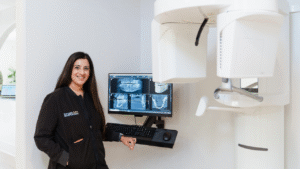
Once the dentist determines that a crown is appropriate, the tooth is prepared and digitally scanned. The scan creates a detailed model of the tooth and surrounding bite without relying on a traditional impression that has to be sent to an outside laboratory.
From there, CAD software is used to design the restoration. The dentist can review the crown’s shape, contacts with neighboring teeth, and relationship to the bite before it is created.
The digital design is then sent to an in-office milling system, which shapes the crown from restorative material. Once milling is complete, the dentist checks the fit and bite, makes any needed adjustments, and bonds the crown into place.
The entire workflow happens during the same appointment, so the prepared tooth can usually leave with its permanent restoration rather than a temporary.
You can also learn more about how this technology works in our guide to same-day crowns and CEREC technology.
Are Same-Day Crowns Right for Every Tooth?
Convenience is the most obvious benefit of a same-day crown, but it is not the only one.
Because the permanent restoration can be completed during the same appointment, patients can usually avoid wearing a temporary crown. Temporary restorations can occasionally loosen, break, or feel different from the final crown, so completing treatment in one visit removes that intermediate step.
The digital workflow also allows the dentist to evaluate the crown’s fit and bite before it is permanently placed. If an adjustment is needed, it can be made while the patient is still in the office rather than requiring a second appointment.
Same-day technology still depends on careful treatment planning. Not every damaged tooth needs a crown, and not every crown case is necessarily suited to a one-visit workflow.
A smaller area of damage may be treated more conservatively, while a tooth with deeper decay, a significant fracture, or other complications may need additional treatment before it can be restored. The amount of healthy tooth structure that remains, along with the way the tooth functions within the bite, both influence the recommendation.
The dentist also needs to prepare the tooth appropriately, preserve healthy structure whenever possible, and make sure the final crown supports comfortable, long-term function.
If you have a cracked, weakened, or heavily restored tooth, visit our Arlington dental studio or contact us to schedule an evaluation. We can assess the damage, explain your restorative options, and determine whether a same-day crown is an appropriate way to restore the tooth efficiently and predictably.